Mimesis

Mimesis (/maɪˈmiːsəs/; Ancient Greek: μίμησις (mīmēsis), from μιμεῖσθαι (mīmeisthai), "to imitate," from μῖμος (mimos), "imitator, actor") is a critical and philosophical term that carries a wide range of meanings, which include imitation, representation, mimicry,imitatio, receptivity, nonsensuous similarity, the act of resembling, the act of expression, and the presentation of the self.[1]
Catharsis

Catharsis (from Greek κάθαρσις katharsis meaning "purification" or "cleansing") is the purification and purgation of emotions—especially pity and fear—through art[1] or any extreme change in emotion that results in renewal and restoration.[2][3] It is a metaphor originally used by Aristotle in the Poetics, comparing the effects of tragedy on the mind of spectator to the effect of a cathartic on the body.[4][5]
Harmatia

The term hamartia derives from the Greek ἁμαρτία, from ἁμαρτάνειν hamartánein, which means "to miss the mark" or "to err".[1][2] It is most often associated with Greek tragedy, although it is also used in Christian theology.[3]Hamartia as it pertains to dramatic literature was first used by Aristotle in his Poetics. In tragedy, hamartia is commonly understood to refer to the protagonist’s error or flaw that leads to a chain of plot actions culminating in a reversal from their good fortune to bad. What qualifies as the error or flaw can include an error resulting from ignorance, an error of judgement, a flaw in character, or sin. The spectrum of meanings has invited debate among critics and scholars, and different interpretations among dramatists.
Hamlet
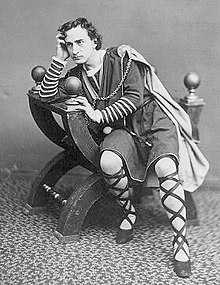
The Tragedy of Hamlet, Prince of Denmark, often shortened to Hamlet (/ˈhæmlᵻt/), is a tragedy written by William Shakespeare at an uncertain date between 1599 and 1602. Set in the Kingdom of Denmark, the play dramatises the revenge Prince Hamlet is called to wreak upon his uncle, Claudius, by the ghost of Hamlet's father, King Hamlet. Claudius had murdered his own brother and seized the throne, also marrying his deceased brother's widow. Hamlet is Shakespeare's longest play, and is ranked among the most powerful and influential tragedies in English literature, with a story capable of "seemingly endless retelling and adaptation by others".[1] The play likely was one of Shakespeare's most popular works during his lifetime,[2] and still ranks among his most performed, topping the performance list of the Royal Shakespeare Company and its predecessors in Stratford-upon-Avon since 1879.[3] It has inspired many other writers – from Johann Wolfgang von Goethe and Charles Dickens to James Joyce and Iris Murdoch – and has been described as "the world's most filmed story after Cinderella".[4]
A Midsummer Night's Dream
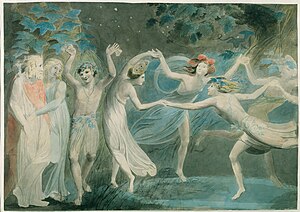
A Midsummer Night's Dream is a comedy written by William Shakespeare sometime between 1590 and 1597. It portrays the events surrounding the marriage of Theseus, the Duke of Athens, to Hippolyta. These include the adventures of four young Athenian lovers and a group of six amateur actors (the mechanicals) who are controlled and manipulated by the fairies who inhabit the forest in which most of the play is set. The play is one of Shakespeare's most popular works for the stage and is widely performed across the world.
William Shakespeare
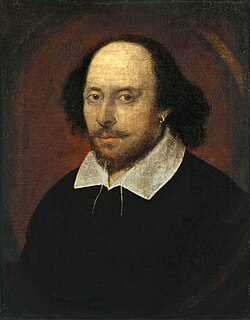
William Shakespeare (/ˈʃeɪkspɪər/;[1] 26 April 1564 (baptised) – 23 April 1616)[nb 1] was an English poet, playwright, and actor, widely regarded as the greatest writer in the English language and the world's pre-eminent dramatist.[2] He is often called England's national poet, and the "Bard of Avon".[3][nb 2] His extant works, including collaborations, consist of approximately 38 plays,[nb 3] 154 sonnets, two long narrative poems, and a few other verses, some of uncertain authorship. His plays have been translated into every major living language and are performed more often than those of any other playwright.[4]

沒有留言:
張貼留言