The Waste Land

The Waste Land is a long poem by T. S. Eliot. It is widely regarded as one of the most important poems of the 20th century and a central text in Modernist poetry.[2][3] Published in 1922, the 434-line[B] poem first appeared in the United Kingdom in the October issue of The Criterion and in the United States in the November issue of The Dial. It was published in book form in December 1922. Among its famous phrases are "April is the cruellest month", "I will show you fear in a handful of dust", and the mantra in the Sanskrit language "Shantih shantih shantih".[C]
Eliot's poem loosely follows the legend of the Holy Grail and the Fisher King combined with vignettes of contemporary British society. Eliot employs many literary and cultural allusions from the Western canon, Buddhismand the Hindu Upanishads. Because of this, critics and scholars regard the poem as obscure.[4] The poem shifts between voices of satire and prophecy featuring abrupt and unannounced changes of speaker, location, and time and conjuring of a vast and dissonant range of cultures and literatures.
The poem's structure is divided into five sections. The first section, The Burial of the Dead, introduces the diverse themes of disillusionment and despair. The second, A Game of Chess, employs vignettes of several characters—alternating narrations—that address those themes experientially. The Fire Sermon, the third section, offers a philosophical meditation in relation to the imagery of death and views of self-denial in juxtaposition influenced by Augustine of Hippo and eastern religions. After a fourth section that includes a brief lyrical petition, the culminating fifth section, What the Thunder Said, concludes with an image of judgment.
E. E. Cummings

Edward Estlin Cummings (October 14, 1894 – September 3, 1962), known as E. E. Cummings, with the abbreviated form of his name often written by others in lowercase letters as e e cummings (in the style of some of his poems—see name and capitalization, below), was an American poet, painter, essayist, author, and playwright. His body of work encompasses approximately 2,900 poems, two autobiographical novels, four plays and several essays, as well as numerous drawings and paintings. He is remembered as an eminent voice of 20th century English literature.
The Canterbury tales
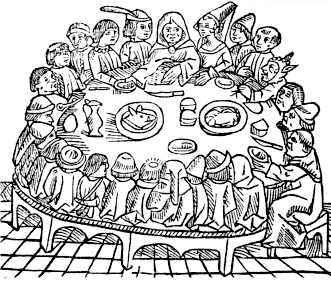
The Canterbury Tales (Middle English: Tales of Caunterbury[2]) is a collection of 24 stories that runs to over 17,000 lines written in Middle English by Geoffrey Chaucer. In 1386, Chaucer became Controller of Customs and Justice of Peace and, three years later, Clerk of the King's work in 1389. It was during these years that Chaucer began working on his most famous text, The Canterbury Tales. The tales (mostly written in verse, although some are in prose) are presented as part of a story-telling contest by a group of pilgrims as they travel together on a journey from London to Canterbury in order to visit the shrine of Saint Thomas Becket at Canterbury Cathedral. The prize for this contest is a free meal at the Tabard Inn at Southwark on their return.

沒有留言:
張貼留言