Church

A church building, often simply called a church, is a building used for religious activities, particularly worship services. The term in its architectural sense is most often used by Christians to refer to their religious buildings; they can be used by other religions.[1] In traditional Christian architecture, the church is often arranged in the shape of a Christian cross. When viewed from plan view the longest part of a cross is represented by the aisle and the junction of the cross is located at the altar area.
Chapel

A chapel is a religious place of fellowship, prayer and worship that is attached to a larger, often nonreligious institution or that is considered an extension of a primary religious institution. It may be part of a larger structure or complex, such as a college, hospital, palace, prison, funeral home, church, synagogue or mosque,[1] located on board a military or commercial ship, or it may be an entirely free-standing building, sometimes with its own grounds.[2] Many military installations have chapels for the use of military personnel, normally under the leadership of a military chaplain.
Cathedral
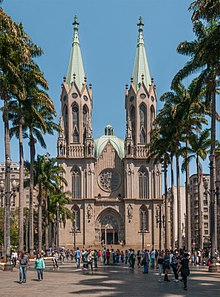
A cathedral (French: cathédrale from Latin: cathedra, "seat" from the Greek kathedra (καθέδρα), seat, bench, from kata "down" + hedra seat, base, chair) is a Christian church which contains the seat of a bishop,[1] thus serving as the central church of a diocese, conference, or episcopate.[2] The counterpart term for such a church in German is Dom from Latin domus ecclesiae or domus episcopalis; also Italian Duomo, Dutch Domkerk and cognates in many other European languages. Churches with the function of "cathedral" are usually specific to those Christian denominations with an episcopal hierarchy, such as the Roman Catholic, Anglican, Orthodox, and some Lutheran and Methodist churches.[2] Church buildings embodying the functions of a cathedral first appear in Italy, Gaul, Spain and North Africa in the 4th century, but cathedrals did not become universal within the Western Catholic Church until the 12th century, by which time they had developed architectural forms, institutional structures and legal identities distinct from parish churches, monastic churches and episcopal residences.
Charles Dickens
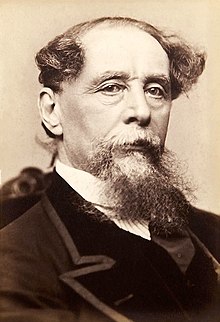
Charles John Huffam Dickens (/ˈtʃɑːrlz ˈdɪkɪnz/; 7 February 1812 – 9 June 1870) was an English writer and social critic. He created some of the world's best-known fictional characters and is regarded as the greatest novelist of the Victorian era.[1] His works enjoyed unprecedented popularity during his lifetime, and by the twentieth century critics and scholars had recognised him as a literary genius. His novels and short stories enjoy lasting popularity.[2][3]

沒有留言:
張貼留言