Hamlet
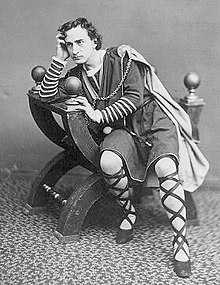
The Tragedy of Hamlet, Prince of Denmark, often shortened to Hamlet (/ˈhæmlᵻt/), is a tragedy written by William Shakespeare at an uncertain date between 1599 and 1602. Set in the Kingdom of Denmark, the play dramatises the revenge Prince Hamlet is called to wreak upon his uncle, Claudius, by the ghost of Hamlet's father, King Hamlet. Claudius had murdered his own brother and seized the throne, also marrying his deceased brother's widow. Hamlet is Shakespeare's longest play, and is ranked among the most powerful and influential tragedies in English literature, with a story capable of "seemingly endless retelling and adaptation by others".[1] The play likely was one of Shakespeare's most popular works during his lifetime,[2] and still ranks among his most performed, topping the performance list of the Royal Shakespeare Company and its predecessors in Stratford-upon-Avon since 1879.[3] It has inspired many other writers – from Johann Wolfgang von Goethe and Charles Dickens to James Joyce and Iris Murdoch – and has been described as "the world's most filmed story after Cinderella".[4]
The story of Shakespeare's Hamlet was derived from the legend of Amleth, preserved by 13th-century chronicler Saxo Grammaticus in his Gesta Danorum, as subsequently retold by 16th-century scholar François de Belleforest. Shakespeare may also have drawn on an earlier (hypothetical) Elizabethan play known today as the Ur-Hamlet, though some scholars believe he himself wrote the Ur-Hamlet, later revising it to create the version ofHamlet we now have. He almost certainly wrote his version of the title role for his fellow actor, Richard Burbage, the leading tragedian of Shakespeare's time.[5] In the 400 years since its inception, the role has been performed by numerous highly acclaimed actors in each successive century.
Three different early versions of the play are extant: the First Quarto (Q1, 1603); the Second Quarto (Q2, 1604); and the First Folio (F1, 1623). Each version includes lines and entire scenes missing from the others. The play's structure and depth of characterisation have inspired much critical scrutiny. One such example is the centuries-old debate about Hamlet's hesitation to kill his uncle, which some see as merely a plot device to prolong the action, but which others argue is a dramatisation of the complex philosophical and ethical issues that surround cold-blooded murder, calculated revenge, and thwarted desire. More recently, psychoanalytic critics have examined Hamlet's unconscious desires, while feminist critics have re-evaluated and attempted to rehabilitate the often maligned characters of Ophelia and Gertrude.
Roman Fever

The protagonists are Grace Ansley and Alida Slade, two middle-aged American women who are visiting Rome with their daughters, Barbara Ansley and Jenny Slade. The elder women grew up in Manhattan, New York, and were friends from childhood. A youthful and romantic rivalry led Mrs. Slade to nurture feelings of jealousy and hatred against Mrs. Ansley.
In the opening pages of the story, the two women compare their daughters and reflect on each other's lives. Eventually, Mrs. Slade reveals a secret about a letter written to Mrs. Ansley on a visit to Rome many years ago. The letter was purportedly from Mrs. Slade's fiancé, Delphin, inviting Mrs. Ansley to a rendezvous at the Colosseum. In fact, Mrs. Slade herself had written the letter, in an attempt to get Mrs. Ansley out of the way of the engagement by disappointing her with Delphin's absence (and, it is implied, to get Mrs. Ansley sick with Roman Fever). Mrs. Ansley is upset at this revelation, but reveals that she was not left alone at the Colosseum—she responded to the letter, and Delphin arrived to meet her. Mrs. Slade eventually states that Mrs. Ansley ought not to feel sorry for her, because "I had [Delphin] for twenty-five years" while Mrs. Ansley had "nothing but a letter he didn't write." Mrs. Ansley responds, in the last sentence of the story, "I had Barbara."
I wondered lonely as a child

The poem was inspired by an event on 15 April 1802, in which Wordsworth and his sister Dorothy came across a "long belt" of daffodils. Written some time between 1804 and 1807 (in 1804 by Wordsworth's own account),[4] it was first published in 1807 in Poems in Two Volumes, and a revised version was published in 1815.[5]
In a poll conducted in 1995 by the BBC Radio 4 Bookworm programme to determine the nation's favourite poems, I Wandered Lonely as a Cloud came fifth.[6] Often anthologised, the poem is commonly seen as a classic of English romantic poetry, although Poems in Two Volumes, in which it first appeared, was poorly reviewed by Wordsworth's contemporaries.
William Wordsworth

William Wordsworth (7 April 1770 – 23 April 1850) was a major English Romantic poet who, with Samuel Taylor Coleridge, helped to launch the Romantic Age in English literature with their joint publication Lyrical Ballads(1798).
Wordsworth's magnum opus is generally considered to be The Prelude, a semiautobiographical poem of his early years that he revised and expanded a number of times. It was posthumously titled and published, before which it was generally known as "the poem to Coleridge".[1] Wordsworth was Britain's Poet Laureate from 1843 until his death in 1850.[2]

沒有留言:
張貼留言