Romanticism

Romanticism (also the Romantic era or the Romantic period) was an artistic, literary, musical and intellectual movement that originated in Europe toward the end of the 18th century and in most areas was at its peak in the approximate period from 1800 to 1850
Neoclassicism

eoclassicism (from Greek νέος nèos, "new" and Latin classicus, "of the highest rank")[1] is the name given to Western movements in the decorative and visual arts, literature, theatre, music, and architecture that draw inspiration from the "classical" art and culture of Ancient Greece or Ancient Rome. Neoclassicism was born in Rome in the mid-18th century, but its popularity spread all over Europe, as a generation of European art students finished their Grand Tour and returned from Italy to their home countries with newly rediscovered Greco-Roman ideals.[2] The main Neoclassical movement coincided with the 18th-century Age of Enlightenment, and continued into the early 19th century, latterly competing with Romanticism. In architecture, the style continued throughout the 19th, 20th and up to the 21st century.
Modernism

Modernism is a philosophical movement that, along with cultural trends and changes, arose from wide-scale and far-reaching transformations in Western society in the late 19th and early 20th centuries. Among the factors that shaped modernism were the development of modern industrial societies and the rapid growth of cities, followed then by the horror of World War I. Modernism also rejected the certainty of Enlightenment thinking, and many modernists rejected religious belief.[2][3]
Individualism

Individualism is the moral stance, political philosophy, ideology, or social outlook that emphasizes the moral worth of the individual.[1][2] Individualists promote the exercise of one's goals and desires and so valueindependence and self-reliance[3] and advocate that interests of the individual should achieve precedence over the state or a social group,[3] while opposing external interference upon one's own interests by society orinstitutions such as the government.[3] Individualism is often defined in contrast to totalitarianism or collectivism.[4][5]
Rapenzel
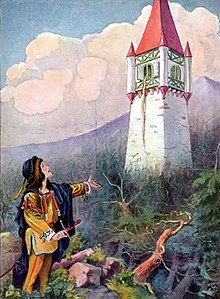
"Rapunzel" (/rəˈpʌnzəl/; German pronunciation: [ʁaˈpʊnt͡səl]) is a German fairy tale in the collection assembled by the Brothers Grimm, and first published in 1812 as part of Children's and Household Tales.[1] The Grimm Brothers' story is an adaptation of the fairy tale Rapunzel by Friedrich Schulz published in 1790.[2] The Schulz version is based on Persinette by Charlotte-Rose de Caumont de La Force originally published in 1698[3]which in turn was influenced by an even earlier tale, Petrosinella by Giambattista Basile, published in 1634.[4] Its plot has been used and parodied in various media and its best known line ("Rapunzel, Rapunzel, let down your hair") is an idiom of popular culture. In volume I of the 1812 annotations (Anhang), it is listed as coming from Friedrich Schulz Kleine Romane, Book 5, pp. 269–288, published in Leipzig 1790.

沒有留言:
張貼留言