Virgil

Publius Vergilius Maro (Classical Latin: [ˈpuː.blɪ.ʊs wɛrˈɡɪ.lɪ.ʊs ˈma.roː]; October 15, 70 BC – September 21, 19 BC), usually called Virgil or Vergil /ˈvɜːrdʒᵻl/ in English, was an ancient Roman poet of the Augustan period. He is known for three major works of Latin literature, the Eclogues (or Bucolics), the Georgics, and the epic Aeneid. A number of minor poems, collected in the Appendix Vergiliana, are sometimes attributed to him.
Virgil is traditionally ranked as one of Rome's greatest poets. His Aeneid has been considered the national epic of ancient Rome from the time of its composition to the present day. Modeled after Homer's Iliad andOdyssey, the Aeneid follows the Trojan refugee Aeneas as he struggles to fulfill his destiny and arrive on the shores of Italy—in Roman mythology the founding act of Rome. Virgil's work has had wide and deep influence on Western literature, most notably Dante's Divine Comedy, in which Virgil appears as Dante's guide through hell and purgatory.
Virtual Reality

Virtual reality or virtual realities (VR), also known as immersive multimedia or computer-simulated reality, is a computer technology that replicates an environment, real or imagined, and simulates a user's physical presence and environment to allow for user interaction. Virtual realities artificially create sensory experience, which can include sight, touch, hearing, and smell.
Most up-to-date virtual realities are displayed either on a computer monitor or with a virtual reality headset (also called head-mounted display), and some simulations include additional sensory information and focus on real sound through speakers or headphones targeted towards VR users. Some advanced haptic systems now include tactile information, generally known as force feedback in medical, gaming and military applications. Furthermore, virtual reality covers remote communication environments which provide virtual presence of users with the concepts of telepresence and telexistence or a virtual artifact (VA) either through the use of standard input devices such as a keyboard and mouse, or through multimodal devices such as a wired glove or omnidirectional treadmills. The immersive environment can be similar to the real world in order to create a lifelike experience—for example, in simulations for pilot or combat training—or it can differ significantly from reality, such as in VR games.
Ode on a Grecian Urn
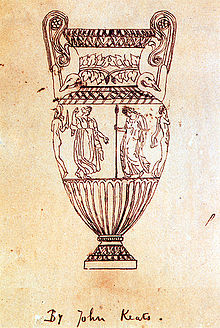
"Ode on a Grecian Urn" is a poem written by the English Romantic poet John Keats in May 1819 and published anonymously in the January 1820, Number 15 issue of the magazine Annals of the Fine Arts (see 1820 in poetry).
The poem is one of several "Great Odes of 1819", which include "Ode on Indolence", "Ode on Melancholy", "Ode to a Nightingale", and "Ode to Psyche". Keats found earlier forms of poetry unsatisfactory for his purpose, and the collection represented a new development of the ode form. He was inspired to write the poem after reading two articles by English artist and writer Benjamin Haydon. Keats was aware of other works on classical Greek art, and had first-hand exposure to the Elgin Marbles, all of which reinforced his belief that classical Greek art was idealistic and captured Greek virtues, which forms the basis of the poem.

沒有留言:
張貼留言