John Keats
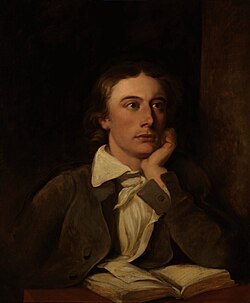
John Keats (/ˈkiːts/ 31 October 1795 – 23 February 1821) was an English Romantic poet. He was one of the main figures of the second generation of Romantic poets, along with Lord Byron and Percy Bysshe Shelley, despite his work having been in publication for only four years before his death.[1]
Although his poems were not generally well received by critics during his lifetime, his reputation grew after his death, and by the end of the 19th century, he had become one of the most beloved of all English poets. He had a significant influence on a diverse range of poets and writers. Jorge Luis Borges stated that his first encounter with Keats's work was the most significant literary experience of his life.[2]
The poetry of Keats is characterised by sensual imagery, most notably in the series of odes. This is typical of romantic poets, as they aimed to accentuate extreme emotion through the emphasis of natural imagery. Today his poems and letters are some of the most popular and most analysed in English literature.
John Donne

John Donne (/ˈdʌn/ dun) (22 January 1572[1] – 31 March 1631) was an English poet and a cleric in the Church of England. He is considered the pre-eminent representative of the metaphysical poets. His works are noted for their strong, sensual style and include sonnets, love poems, religious poems, Latin translations, epigrams, elegies, songs, satires and sermons. His poetry is noted for its vibrancy of language and inventiveness ofmetaphor, especially compared to that of his contemporaries. Donne's style is characterised by abrupt openings and various paradoxes, ironies and dislocations. These features, along with his frequent dramatic or everyday speech rhythms, his tense syntax and his tough eloquence, were both a reaction against the smoothness of conventional Elizabethan poetry and an adaptation into English of European baroque and mannerist techniques. His early career was marked by poetry that bore immense knowledge of English society and he met that knowledge with sharp criticism. Another important theme in Donne's poetry is the idea of true religion, something that he spent much time considering and about which he often theorized. He wrote secular poems as well as erotic and love poems. He is particularly famous for his mastery of metaphysical conceits.[2]
Despite his great education and poetic talents, Donne lived in poverty for several years, relying heavily on wealthy friends. He spent much of the money he inherited during and after his education on womanising, literature, pastimes, and travel. In 1601, Donne secretly married Anne More, with whom he had twelve children.[3] In 1615, he became an Anglican priest, although he did not want to take Anglican orders. He did so because King James I persistently ordered it. In 1621, he was appointed the Dean of St Paul's Cathedral in London. He also served as a member of Parliament in 1601 and in 1614.
La Belle Dame sans Merci

Poem:
O what can ail thee, knight-at-arms,
Alone and palely loitering?
The sedge has withered from the lake,
And no birds sing.
O what can ail thee, knight-at-arms,
So haggard and so woe-begone?
The squirrel’s granary is full,
And the harvest’s done.
I see a lily on thy brow,
With anguish moist and fever-dew,
And on thy cheeks a fading rose
Fast withereth too.
I met a lady in the meads,
Full beautiful, a fairy’s child;
Her hair was long, her foot was light,
And her eyes were wild.
I made a garland for her head,
And bracelets too, and fragrant zone;
She looked at me as she did love,
And made sweet moan
I set her on my pacing steed,
And nothing else saw all day long,
For sidelong would she bend, and sing
A faery’s song.
She found me roots of relish sweet,
And honey wild, and manna-dew,
And sure in language strange she said—
‘I love thee true’.
She took me to her Elfin grot,
And there she wept and sighed full sore,
And there I shut her wild, wild eyes
With kisses four.
And there she lullèd me asleep,
And there I dreamed—Ah! woe betide!—
The latest dream I ever dreamt
On the cold hill side.
I saw pale kings and princes too,
Pale warriors, death-pale were they all;
They cried—‘La Belle Dame sans Merci
Hath thee in thrall!’
I saw their starved lips in the gloam,
With horrid warning gapèd wide,
And I awoke and found me here,
On the cold hill’s side.
And this is why I sojourn here,
Alone and palely loitering,
Though the sedge is withered from the lake,
And no birds sing.
Sonnet 18

Sonnet 18, often alternatively titled Shall I compare thee to a summer's day?, is one of the best-known of 154 sonnets written by the English playwright and poet William Shakespeare. Part of the Fair Youth sequence (which comprises sonnets 1–126 in the accepted numbering stemming from the first edition in 1609), it is the first of the cycle after the opening sequence now described as the procreation sonnets. In the sonnet, the speaker compares his beloved to the summer season, and argues that his beloved is better. He also states that his beloved will live on forever through the words of the poem. Scholars have found parallels within the poem to Ovid's Tristia and Amores, both of which have love themes. Sonnet 18 is written in the typical Shakespearean sonnet form, having 14 lines of iambic pentameterending in a rhymed couplet. Detailed exegeses have revealed several double meanings within the poem, giving it a greater depth of interpretation.

沒有留言:
張貼留言